What is Robotic Process Automation (RPA)? And How Does It Differ from AI?
By Marios Manolakeris on August 24, 2025
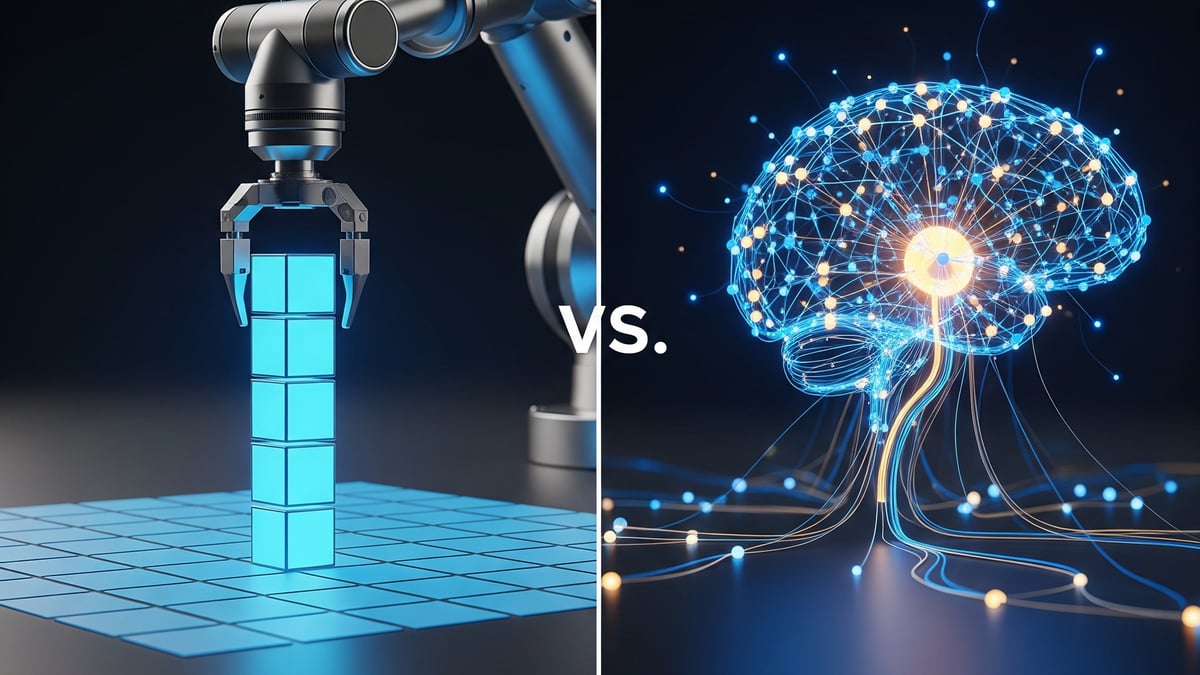
As a consultant for Dutch scale-ups, I often hear founders use "AI" and "Robotic Process Automation (RPA)" interchangeably. It's an easy mistake to make; both promise efficiency and a smarter way of working. However, they are fundamentally different tools designed to solve different types of problems.
Choosing the wrong approach can lead to a stalled project, wasted investment, and frustration. You wouldn't use a hammer to turn a screw. Similarly, applying AI to a simple, repetitive task is overkill, while expecting RPA to make complex judgments is a recipe for failure.
This article will give you a clear, practical understanding of RPA vs AI, so you can make the right strategic decision for your business automation journey.
What Exactly is Robotic Process Automation (RPA)? Think Digital Worker
At its core, Robotic Process Automation (RPA) is about imitation. It's software designed to mimic the repetitive, rule-based actions a human performs on a computer. Think of it as a digital worker that you can train to execute a precise sequence of tasks.
If you can document a process in a step-by-step flowchart, it's likely a prime candidate for RPA. The 'bot' doesn't think or learn; it just follows the script you give it, perfectly, every single time.
Common use cases for RPA in the Netherlands include:
- Data Entry: Copying customer information from a registration form into your CRM.
- Invoice Processing: Extracting data like invoice numbers and amounts from structured PDFs and entering it into accounting software like Exact Online.
- HR Onboarding: Creating user accounts for new hires across multiple systems (email, HR platform, project management tool).
- Report Generation: Logging into various systems, pulling specific numbers, and compiling them into a weekly report spreadsheet.
These tasks are essential but low-value. Using RPA frees your skilled employees from manual drudgery, reducing errors and allowing them to focus on more strategic work. It’s a cornerstone of effective Process Automation & Integration.
And What is Artificial Intelligence (AI)? The Digital Thinker
If RPA is the "hands," Artificial Intelligence (AI) is the "brain." AI isn't about following a pre-defined script; it's about building systems that can analyze information, recognize patterns, learn from data, and make predictions or judgments. This is where machine intelligence comes into play.
AI excels where the rules are not clear-cut and where interpretation is needed. It’s designed to handle variability and complexity that would break a simple RPA bot.
Examples of AI in a business context include:
- Intelligent Customer Support: An AI model can read an incoming support email, understand its sentiment (is the customer angry or just asking a question?), and automatically route it to the correct department.
- Sales Forecasting: Analyzing historical sales data, market trends, and customer behaviour to predict future revenue more accurately than a human could.
- Content Creation: Using generative AI to draft initial marketing copy or product descriptions based on a set of prompts.
- Anomaly Detection: Monitoring network traffic to identify unusual patterns that might indicate a security threat.
As an AI automation agency consultant, I help businesses identify these opportunities to build AI solutions in the Netherlands that create a real competitive advantage. For deeper insights, check out my services or get in touch.
RPA vs AI: The Core Difference is "Doing" vs. "Thinking"
The easiest way to separate them is to think about their fundamental purpose.
RPA is process-driven. It follows rules. Its goal is to automate tasks for efficiency and accuracy.
- Input: Requires structured data (e.g., fields in a form, cells in a spreadsheet).
- Action: "Copy the value from field A and paste it into field B."
AI is data-driven. It creates its own rules through learning. Its goal is to simulate human intelligence for insight and decision-making.
- Input: Can handle unstructured data (e.g., text from an email, images, voice recordings).
- Action: "Read this email and determine if the customer is likely to churn."
Better Together: The Power of Intelligent Automation
The real magic happens when you combine RPA and AI. This is often called Intelligent Automation or Hyperautomation—leveraging workflow orchestration platforms for seamless integration. Here, AI does the thinking, and RPA does the doing.
Imagine this workflow:
- AI (The Thinker): An AI model receives an unstructured invoice as a photo attached to an email. It uses computer vision and natural language processing to read the image, identify the vendor, invoice amount, and due date, and turns that unstructured data into structured information.
- RPA (The Doer): The AI passes this clean, structured data to an RPA bot. The bot then logs into your accounting system, enters the invoice details, and flags it for payment—no human intervention required.
This combination of automated reasoning and reliable execution is what allows for true end-to-end business process automation (BPA) solutions.
Real-World Proof: How I've Applied RPA and AI for Scale-Ups
In one project for a Dutch scale-up, the client was bogged down by manual support ticket handling—data silos between Zendesk and Confluence led to inconsistent responses and high resolution times. I engineered an AI-Powered Support Assistant using Azure Functions and Python to integrate the systems. The AI analyzed ticket sentiment and content for intelligent routing, while RPA handled the rote data transfers. The result? Ticket resolution time dropped by 30%, freeing the team for strategic work and ensuring ISO 27001 compliance. This de-risked their growth phase and reduced support overload.
Which Path is Right for Your Scale-Up?
Choosing the right tool is the first step toward building a robust operational backbone for your company.
- If your pain point is teams being bogged down by repetitive, high-volume digital tasks, start by exploring Robotic Process Automation (RPA) Netherlands.
- If your challenges are more complex—related to making sense of large datasets, prediction, or understanding unstructured communication—then an AI solution is the right path.
Often, the answer is a strategic combination of both. As a Founder's Tech Partner, my job is to help you analyze your unique operational challenges and engineer the most effective solution.
Are you ready to stop putting out operational fires and start building a more efficient, scalable business? Let's talk. Schedule your free, no-obligation consultation today, and we'll build a clear automation roadmap for your business.
About the Author

Marios Manolakeris
I help businesses in the Netherlands automate their operations and build powerful digital assets. Learn more.
Read Next
-
5 Signs Your Scale-Up is Ready for AI-Powered Automation
August 17, 2025
-
Case Study: 95% Reduction in HR Onboarding Time for a Dutch Scale-Up
August 19, 2025